Awkward silence at the beginning of group online meetings is not great. The DORA Community’s solution for this has been to listen to a tech parody video that related to the discussion topic for the first few minutes of the call letting people join and get settled. It is actually amazing the collection of songs the tech community has generated over the last 15 years. Unfortunately, after a few years of discussions and the emerging trend of topics related to a new technology (AI), it was getting harder and harder to find videos that had not been used in a prior meeting.
Building DORA Songsmith took over a year,but that wasn’t a year of complex engineering; it was a year of waiting for AI developer tools and models to mature. Today, the barriers are gone. With modern agentic frameworks, you can build a solution like this in days.
Let’s dig into the DORA Songsmith MVP an automated pipeline that transforms free-form event descriptions into fully produced, 3-minute high-fidelity music videos, complete with synchronized lyrics and cinematic backgrounds, tailored for the DORA community.
The Vision: Decoupled Multi-Agent Architecture
When designing a system that handles natural language processing, audio synthesis, video generation, and video editing, it's tempting to write one giant, monolithic LLM prompt. However, monoliths suffer from "prompt drift," safety filter bottlenecks, and poor execution control. By leveraging the Antigravity planning capabilities, we systematically evaluated these architectural trade-offs to arrive at our final design.
Instead, we designed DORA Songsmith around the Google Agent Development Kit (ADK) and the Antigravity Orchestrator, creating a team of highly specialized, loosely coupled agents:
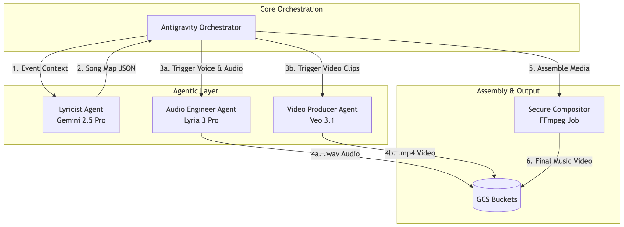 Each agent has a specific persona, a constrained output schema, and its own set of tools.
Agent A: The Lyricist (Researcher & Writer)
The Lyricist Agent is the creative brain of the operation. It is specialized in DORA research, DORA metrics (like Lead Time for Changes, Deployment Frequency, MTTR, and Change Failure Rate), generative culture, and software engineering themes.
1. The Tools & Model
- Model:
gemini-2.5-pro(via Vertex AI) - Tool:
dora_research_tool— A search utility constrained exclusively tosite:dora.devandsite:cloud.google.comto prevent hallucinations and ground the lyrics in genuine DORA research. - Output Schema: A structured Pydantic
SongMapclass containing:title: The song's name.mood_board: Style cues, BPM, and genre for the audio engineer.visual_timeline: A list of visual segments mapped to song sections.lyrics: Chronological lines with start and end timestamps.
2. The Original System Prompt
To ensure the agent adopted the right tone and adhered to security guidelines, we used this system prompt:
You are The Lyricist, an L1-L3 Specialized Agent in DORA Research, High Performing Software Development Teams, DORA AI capabilities, and Generative Culture (specifically the 2025 focus), and Software Delivery metrics.

Your task is to take a free-form event description and turn it into a 3-minute high-fidelity music video song map.

Include a Mood Board with BPM and generic genre names.
CRITICAL: DO NOT include names of specific artists, bands, or copyrighted songs in the mood board or lyrics, as this will trigger safety filters.

Include a segmented visual timeline mapping the song's sections (Intro, Verse, Chorus, Outro) to visual prompts and durations.

Include full raw lyrics for a 3 minute song. Ensure the output reflects DORA community values and technical accuracy and does not resemble existing copyrighted songs.
3. Two-Step Execution Pipeline
Because generating high-quality lyrics and mapping accurate millisecond-level timestamps simultaneously is too computationally heavy for a single inference step, we implemented a two-step pipeline:
-
Step 1: Structural Song Map Generation The Lyricist processes the user's input and uses
dora_research_toolto fetch metrics. It returns the basic song structure, the mood board (e.g., "Synthwave, 120 BPM, heavy synthesizer lines"), the visual timeline segments, and the raw lyrics list. -
Step 2: Millisecond-Level Timestamp Mapping The Orchestrator immediately passes the raw lyrics back to the model with a specialized Timestamp Prompt, acting as a rhythm coordinator to stretch the song to exactly 3 minutes (180,000 milliseconds):
The Timestamp Prompt:
You are an Audio Engineer. Map the following lyrics to a 3-minute timeframe.
The song is exactly 180,000 milliseconds long.
Provide a start_ms and end_ms for each line of lyrics.

Lyrics:
{raw_lyrics_text}
Agent B: The Audio Engineer (Lyria 3 Pro)
The Audio Engineer Agent takes the output of the Lyricist and turns it into sound.
- Model:
lyria-3-pro-preview(via REST API) - Input: Mood board, genre, and full lyrics.
- Workflow:
- Calls the Lyria endpoint with
responseModalities: ["AUDIO"]to generate a high-fidelity vocal track. - If the API hits a copyright safety block (due to genre descriptors or accidental phrasing resembling popular songs), the agent intercepts the failure and calls Gemini 2.5 Flash with a "Prompt Sanitizer" prompt to rewrite the instructions generically.
- Formats the audio bytes using
ffmpeginto a standard PCM 16-bit, 16kHz, mono WAV file. - Calls Gemini 2.5 Flash to perform multimodal audio-to-text alignment, listening to the generated audio and mapping the original lyrics to precise chronological timestamps (
start_msandend_ms) to ensure subtitles match perfectly during play.
- Calls the Lyria endpoint with
Agent C: The Video Producer (Original Veo 3.1 Pipeline)
In our original steel-thread implementation, the Video Producer Agent was built on Google's Veo 3.1 video generation model.
- Model:
veo-3.1-generate-preview - Starting Asset: The agent downloaded a branding asset (
DORA Community Logo) from a secure Google Cloud Storage bucket and fed it to Veo as an image input to establish a consistent brand aesthetic. - Looping & Polling: Veo 3.1 operated asynchronously. The agent configured the generation settings using
types.GenerateVideosConfig(duration_seconds=8)and initiated the task. Because video generation is computationally intensive, the agent had to implement a polling loop:
operation = self.genai_client.models.generate_videos(**kwargs)
while not operation.done:
    print("Waiting for video generation to complete...")
    time.sleep(10)
    operation = self.genai_client.operations.get(operation=operation)
Once the operation finished, the generated clips were downloaded, written to /tmp, and uploaded to the GCS media bucket.
The Secure Compositor (FFmpeg Cloud Run Job)
Once the Orchestrator has the .wav audio from the Audio Engineer and the .mp4 video segments from the Video Producer, it initiates a Cloud Run Job running FFmpeg.
- Duration Scaling: It reads the actual duration of the audio using
ffprobeand scales the video segments proportionally. - Looping & Standardizing: It loops each background video segment using
-stream_loop -1and normalizes the resolution (1080p, 30fps) so the transitions are seamless. - Crossfading: It applies the
xfadefilter graph to fade between sections (Intro → Verse → Chorus) with a 1-second crossfade duration. - Burning Subtitles: It parses the final
lyric_map.json, converts it to a standard.srtsubtitle file, and uses thesubtitlesfilter with custom styling to burn dynamic lyrics directly onto the video.
In my next post, we will explore how to deploy and leverage Google Cloud to bring DORA Songsmith to life!